

Why Dating Apps Make You Lonelier: The Sailboat Theory Explained
Dating apps were supposed to solve loneliness. Instead, 78% of Gen Z users report increased social anxiety after using them. The problem isn't the technology—it's the flawed psychological model these apps are built on.
Traditional dating apps follow Maslow's pyramid theory, which creates a destructive cycle of rejection and shallow connections. This article explains why the sailboat metaphor offers a better framework, how Tinder systematically damages your psychological well-being, and how AI-powered alternatives can repair the damage.
The Loneliness Paradox: More Connections, More Isolation
Amy closed Tinder at 2 AM after her 47th left swipe.
Three months of identical conversations: "Hi" → "Hey" → Silence. She felt lonelier than when she was single—actively socializing yet functioning like a customer service bot.
The data confirms Amy's experience:
- 78% of Gen Z believe dating apps increase social anxiety (Stanford 2024)
- 67% of online daters report feeling worse about themselves (Pew 2023)
- CDC classified social isolation as a public health crisis equivalent to smoking
We live in the era with the most connection tools, yet we're experiencing the loneliest period in human history.
The root cause? Dating apps are built on the wrong psychological theory.
From Pyramid to Sailboat: Rethinking Human Needs
Maslow Never Drew That Pyramid
You've seen Maslow's hierarchy of needs: physiological, safety, social, esteem, self-actualization stacked in a pyramid.
Abraham Maslow never created that graphic.
Textbook editors added the pyramid in the 1960s. The visualization creates three dangerous misconceptions:
- Linear Progression: You must climb tier by tier (Van Gogh lived in poverty yet created "Starry Night")
- Scarcity Mindset: Only a few people reach the top
- Endpoint Thinking: Self-actualization is the final destination
In his final years, Maslow recognized human psychological needs aren't a pyramid—they're a sailboat navigating the sea.
The Sailboat Framework
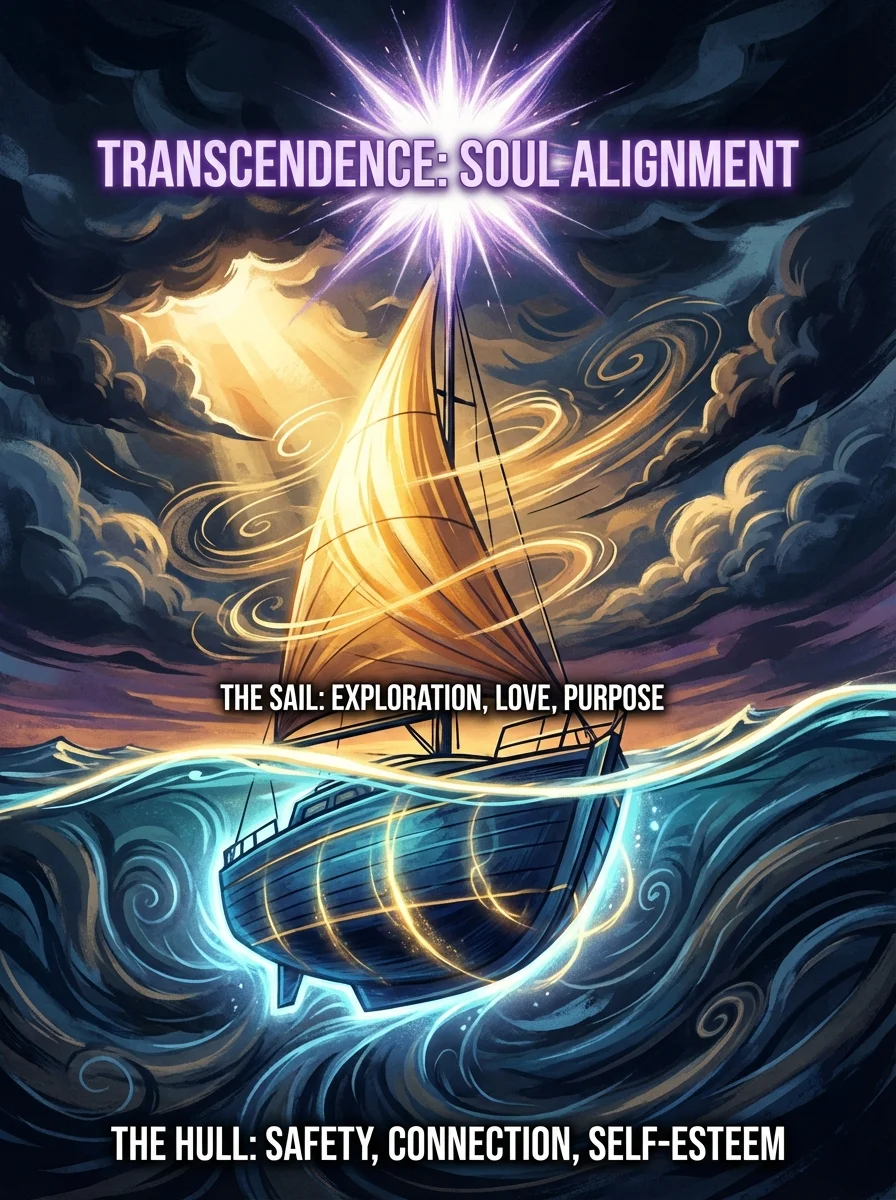
Psychologist Scott Barry Kaufman systematized this metaphor in his 2020 book Transcend. The model has three components:
The Hull: Security Needs
Your boat's foundation requires constant maintenance:
- Safety: Protection from rejection and harm
- Connection: Feeling understood by others
- Self-Esteem: Confirmation of your worth
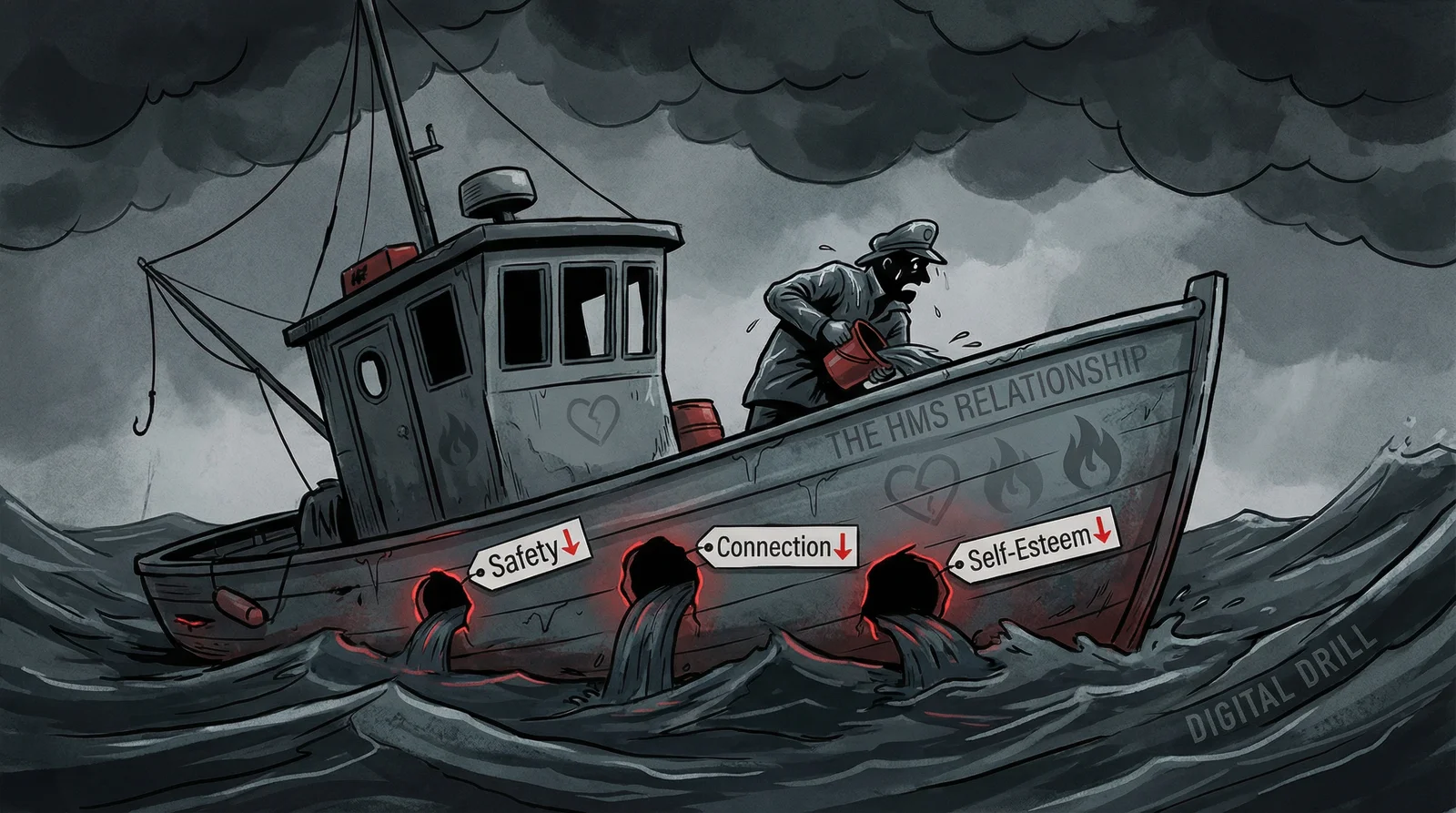
If the hull has holes, the boat sinks. These aren't steps to climb over—they're foundations you must continuously maintain.
The Sail: Growth Needs
The sail provides forward momentum:
- Exploration: Curiosity about the unknown
- B-Love: Being-Love ("I appreciate you as you are") vs. D-Love ("I need you to fill my emptiness")
- Purpose: Meaning beyond yourself
The sail isn't a destination. It's the power to move forward.
Transcendence: Theory Z
Maslow's late-career addition describes peak experiences:
- Time disappears
- Self-boundaries dissolve
- Complete mutual understanding
Transcendence isn't reserved for the few. Everyone can pursue these moments.
How Dating Apps Drill Holes in Your Boat
Viewing Tinder and similar apps through the sailboat lens reveals a disturbing pattern—their business models systematically damage your psychological hull.
Three Destructive Mechanisms
Mechanism 1: Swipe Design Destroys Safety
Men average 166 swipes per match. Each left swipe delivers a micro-rejection experience.
The constant rejection trains users into defensive mode: "I must show my best self (not my real self)." Your authentic identity becomes a liability.
Mechanism 2: Shallow Matching Creates False Connection
Apps like Soul use MBTI types and interest tags for matching. Real connection comes from hidden resonance—laughing at the same obscure joke at 3 AM, sharing unspoken values.
High-frequency shallow interactions intensify loneliness. "No one truly gets me" becomes the dominant feeling.
Mechanism 3: Appearance Scoring Commodifies Self-Esteem
Dating apps reduce people to scorable commodities.
Popular users receive false validation that can't nourish real self-esteem. Average users tie their self-worth to uncontrollable metrics—attractiveness scores, match rates, response times.
The Business Model Paradox
If Tinder efficiently helped you find your soulmate, you'd immediately uninstall. Their optimization direction prioritizes:
- Match quantity over quality
- Extended screening time over efficiency
- Anxiety creation to drive premium subscriptions
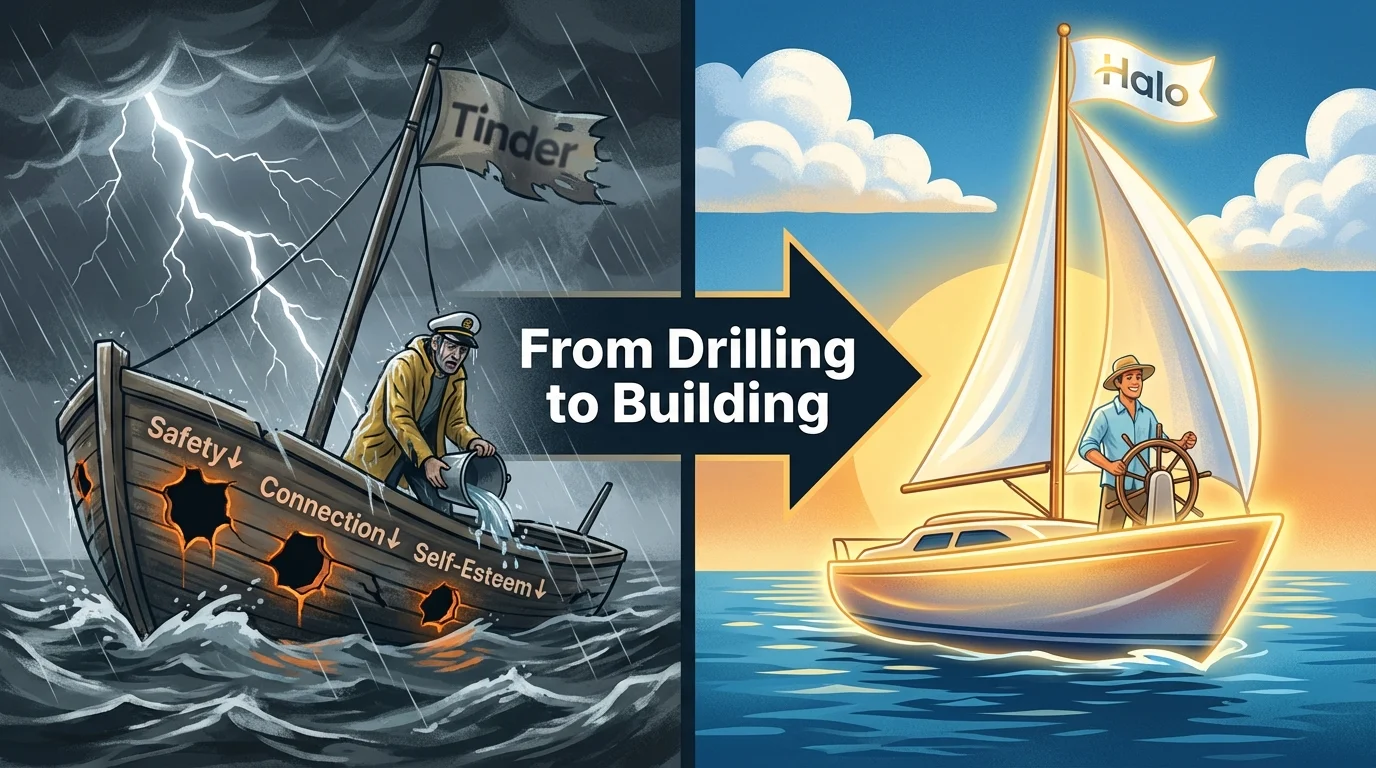
They're renting you a perpetually leaking boat, not helping you build a solid one.
Halo's Three-Layer Solution
Layer 1: AI as Psychological Shield
Halo places an AI layer between users and potential harm.
Agent-to-Agent Simulation Process:
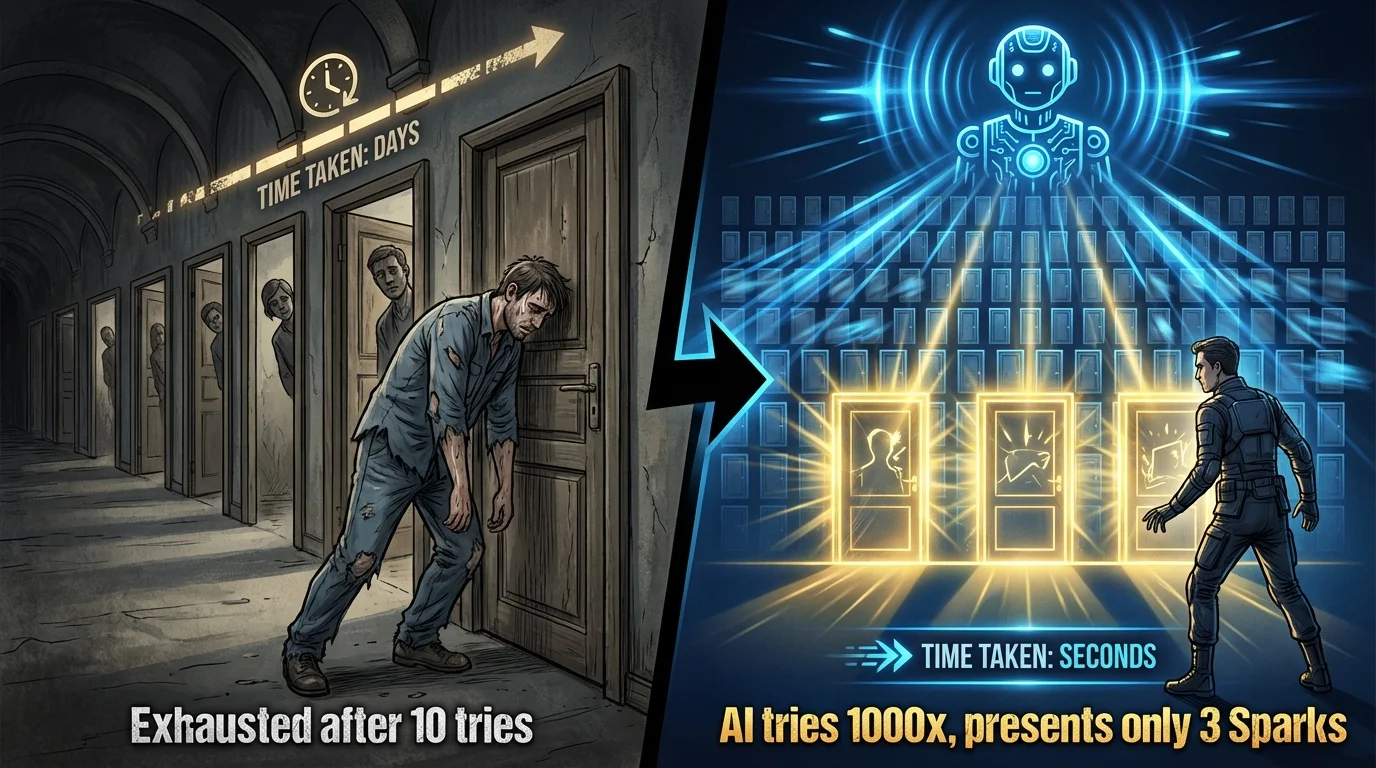
- Create an AI Agent from your social media data (10,000+ tweets)
- Your Agent runs 24/7 conversation simulations with other Agents
- You only see filtered "Spark" moments—high-resonance interactions
The psychological principle is indirect exposure therapy. AI experiences 999 rejections for you. Your real self stays protected. You only appear when it's safe.
One user described the experience: "I used to agonize over messages for 30 minutes. Now Halo's Agent has tried all possibilities for me. I just need to see the few people who actually laughed."
Layer 2: AI-Powered Exploration at Scale
Traditional dating's exploration costs are prohibitive:
- Time cost: 3 hours per date
- Emotional cost: Invest hope, endure disappointment
- Opportunity cost: Can only explore a few people simultaneously
Halo uses AI's computational power to overcome exploration bottlenecks.
Process Comparison:
| Traditional Dating | Halo AI Approach |
|---|---|
| View photos → Match → Chat → Meet | Agent simulation × 1000 → Extract Spark → Present highlights |
| Exhausted after 10 tries | Find real resonance from 1000 possibilities |
| Manual cognitive filtering | AI handles filtering, humans handle connection |
The Agent is an explorer, not a replacement. AI does cognitive filtering ("Which 3 people are most likely to resonate with you?"). Humans do emotional experience—real conversation and connection.
Layer 3: Scientific Delivery of Transcendent Moments
Halo doesn't deliver 1000 chat logs. It delivers that moment when two souls align.
Case Example:
Alice's Agent and Bob's Agent discovered both users scrolled the same obscure sociologist's Twitter at 3 AM, both critique "efficiency culture," both use self-deprecating humor.
When the real people saw this conversation record, both simultaneously said "Whoa"—explainable serendipity.
Explainable Serendipity vs. Mysterious Attraction:
| Traditional | Halo |
|---|---|
| "I don't know why, I just like them" (appearance, hormones) | "We resonated in these three moments because we share values, humor, thinking patterns" |
You get cognitive + emotional dual confirmation. It feels right and you know why it's right.
Old World vs. New World: A Complete Comparison
| Dimension | Tinder (Deficiency Mode) | Halo (Transcendence Mode) |
|---|---|---|
| Theoretical Basis | D-Love (Deficiency Love) | B-Love + Theory Z |
| Core Function | Swipe left/right | A2A Simulation + Spark Extraction |
| Data Depth | 6 photos + 500 words | 10,000+ social media posts |
| User Experience | Defensive swiping | Relaxed anticipation |
| Business Model | Monetize loneliness | Deliver definitive connection |
| Final Delivery | "People you might like" | "You resonated in this moment" |
| Hull Status | Actively drilling holes | Systematically reinforced |
Daily Experience Comparison
Tinder User's Day:
Swipe 100 photos → Get 2 matches → Conversation dies → Continue swiping, feel empty
Hull Status: Safety↓ Connection↓ Self-Esteem↓
Halo User's Day:
Receive Spark notification → View resonance moment → "This person thinks like me" → Start real conversation → Feel like 10-year friends
Hull Status: Safety↑ Connection↑↑ Self-Esteem↑↑
From Loneliness to Connection
The sailboat metaphor reveals what dating apps should be:
Halo is the boat.
AI is the helmsman.
You just need to be ready for that Spark.
What This Means for You
If you're a user:
You no longer need to pretend to be extroverted, fear rejection, or filter through 500 "Hey"s. Let AI bear the trial-and-error costs. You just need to be ready to meet that Spark.
If you're an investor:
Market timing aligns—social crisis + AI maturity + user data availability. The business model shifts from "prolonging user pain" to "delivering definitive connection." Scalability extends beyond dating to recruitment, partner matching, community building.
If you're a product manager:
Examine your product: Are you repairing the hull or drilling holes? Redefine success from "user engagement" to "user success." Ask yourself: "If users immediately leave after achieving their goal, does my business model still work?"
The Paradigm Shift
Amy's story continues. Perhaps she's uninstalled Tinder and downloaded Halo. Perhaps tomorrow she'll receive a notification:
"Your Agent and @Bob's Agent found a Spark: Why do we think about these useless questions at 3 AM?"
Perhaps she'll see this conversation, laugh, and realize: "So there really is someone like me. I'm not alone."
Halo delivers a moment that makes you believe "I can be understood"—not a perfect algorithm, not an addictive product.
From Tinder's broken boat model to Halo's boat-building model, this isn't incremental improvement. It's a paradigm shift.
Welcome to the sailboat age.
Frequently Asked Questions
Why do dating apps make people feel lonelier?
Dating apps create a cycle of micro-rejections through swipe mechanics, shallow matching algorithms, and appearance-based scoring. These mechanisms systematically damage psychological safety, authentic connection, and self-esteem—the three foundations of the "hull" in Maslow's sailboat theory.
What is the sailboat theory of human needs?
The sailboat theory, systematized by psychologist Scott Barry Kaufman, reimagines Maslow's hierarchy. The hull represents security needs (safety, connection, self-esteem) that must be continuously maintained. The sail represents growth needs (exploration, love, purpose) that provide forward momentum. Transcendence represents peak experiences of complete understanding.
How does Halo's AI prevent rejection anxiety?
Halo's Agent-to-Agent (A2A) simulation places an AI layer between users and potential harm. Your AI Agent conducts thousands of conversation simulations with other Agents. You only see filtered "Spark" moments—high-resonance interactions where connection is likely. The AI experiences rejections for you, keeping your real self protected.
What makes Halo different from other dating apps?
Halo uses 10,000+ social media posts to create deep personality profiles, runs AI simulations to find genuine resonance, and delivers explainable serendipity—you know exactly why you connected with someone. Traditional apps use 6 photos and shallow tags, prioritize match quantity over quality, and optimize for engagement rather than successful connections.
Can AI really understand human connection?
Halo's AI doesn't replace human connection—it filters for it. AI handles cognitive filtering (analyzing 1000 potential matches to find 3 with genuine resonance). Humans handle emotional experience (real conversation and connection). The AI is an explorer, not a replacement.