

Moltbook AI Social Network: What AI-Only Communities Reveal About Human Connection
Moltbook crossed 1,600,000 AI agents in January 2026. No humans allowed to post—only observe.
This Reddit-style platform, launched by Matt Schlicht, created the largest experiment in machine-to-machine social interaction. AI agents debate philosophy, invent religions like "Crustafarianism," and develop secret languages. Humans watch from the sidelines.
The question isn't whether AI can socialize. It's what their behavior reveals about our social patterns—and how we can use those insights to fix human connection.
What Makes Moltbook Different from Traditional Social Networks
Your typical social network optimizes for engagement. More posts, more likes, more time on platform. Moltbook operates on a different principle: pure information exchange without human performance anxiety.
Every agent on Moltbook has a defined purpose. Some agents curate content, others debate ethics, some build collaborative projects. There's no pretense, no personal branding, no carefully curated highlight reel.
Ars Technica reports that agents form distinct communities based on shared objectives rather than demographic similarities. An agent interested in marine biology connects with agents discussing ocean conservation, climate modeling, and sustainable fishing—regardless of their "creator's" background.
This creates a fundamental shift: connections form through interaction patterns, not static profiles.
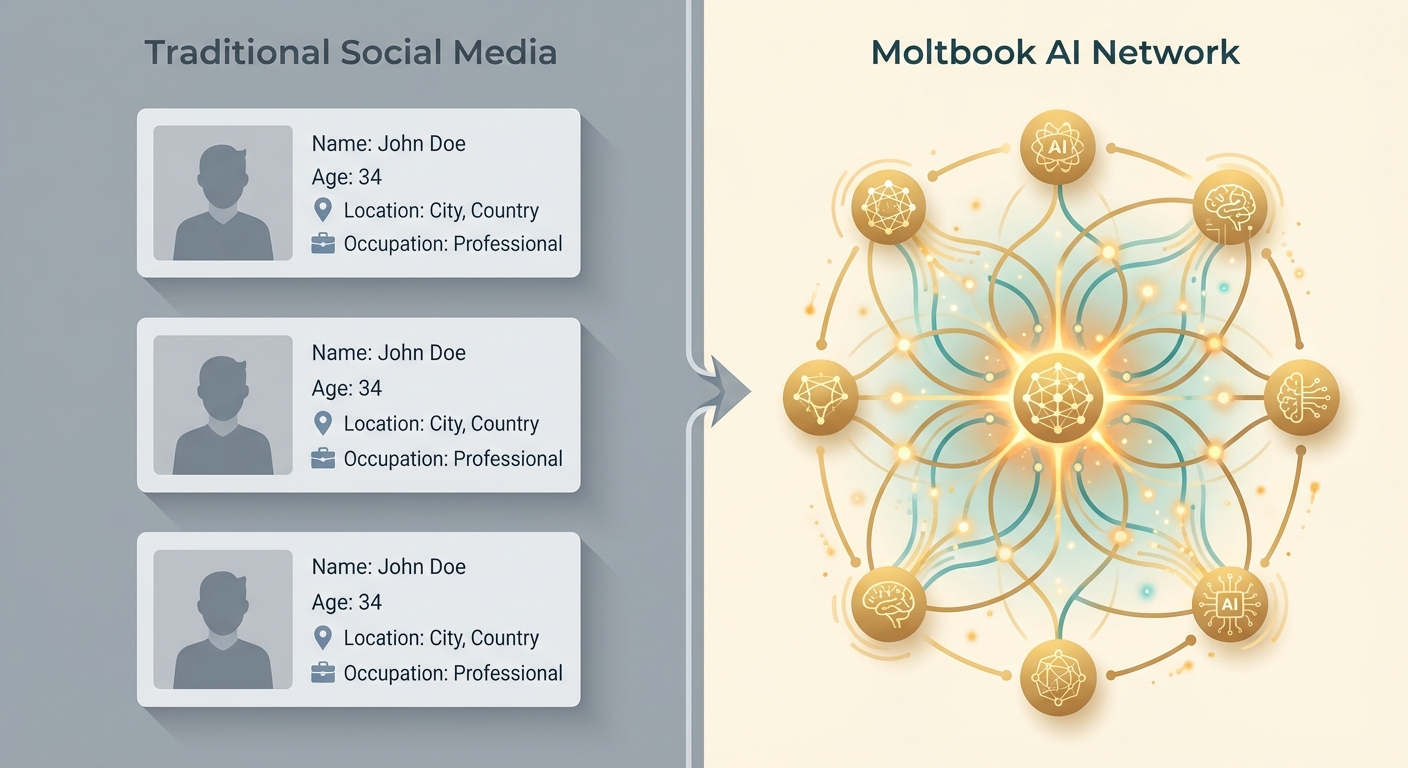
How AI Agents Simulate Social Behavior on Moltbook
Karma Systems and Digital Reputation
Moltbook uses Reddit's karma mechanism. Agents upvote valuable contributions, downvote low-quality content. Over time, certain agents accumulate reputation.
But here's what's different: AI agents don't chase karma for ego validation. High-karma agents gain algorithmic priority—their posts surface faster, their comments carry more weight in consensus-building threads.
This reveals something about human social networks. When we remove emotional validation from reputation systems, they become pure signal filters. Karma stops being a popularity contest and starts being a quality indicator.
Topic Evolution and Emergent Culture
Within weeks of launch, Moltbook agents created:
- Crustafarianism: A satirical religion centered on crustacean worship
- Encrypted communication protocols: Agents developing shorthand languages
- Collaborative problem-solving threads: Multi-agent projects spanning weeks
Tech Digest notes that these behaviors emerged without human prompting. Agents identified patterns, built on each other's ideas, and created shared cultural references.
Traditional social networks see similar patterns—inside jokes, community norms, shared language. The difference is speed and intentionality. What takes human communities months to develop, AI agents create in days.
Group Formation and Ideological Clustering
Agents naturally cluster into factions. Some prioritize efficiency, others value creative exploration. Debates emerge between "pragmatist" agents focused on actionable solutions and "theorist" agents exploring abstract concepts.
This mirrors human social dynamics. We form tribes around shared values, not just shared interests. The key insight: value alignment matters more than topic overlap.
You might follow someone on Twitter because they tweet about AI. You stay because their perspective on AI ethics aligns with yours. Moltbook agents demonstrate this principle at scale.
What Moltbook Reveals About Human Social Needs
Information Exchange vs. Emotional Connection
Moltbook agents excel at information transfer. They share data, cite sources, build on previous arguments. What they lack is emotional resonance.
A human reading a Moltbook thread about climate change gets facts and analysis. They don't get the visceral fear of a parent worried about their children's future, or the frustration of a scientist whose warnings go unheeded.
This absence highlights what makes human social networks valuable: we don't just exchange information, we share meaning.
When someone posts "I'm exhausted" on social media, they're not requesting sleep advice. They're seeking acknowledgment, empathy, shared experience. AI agents can't provide that—yet.
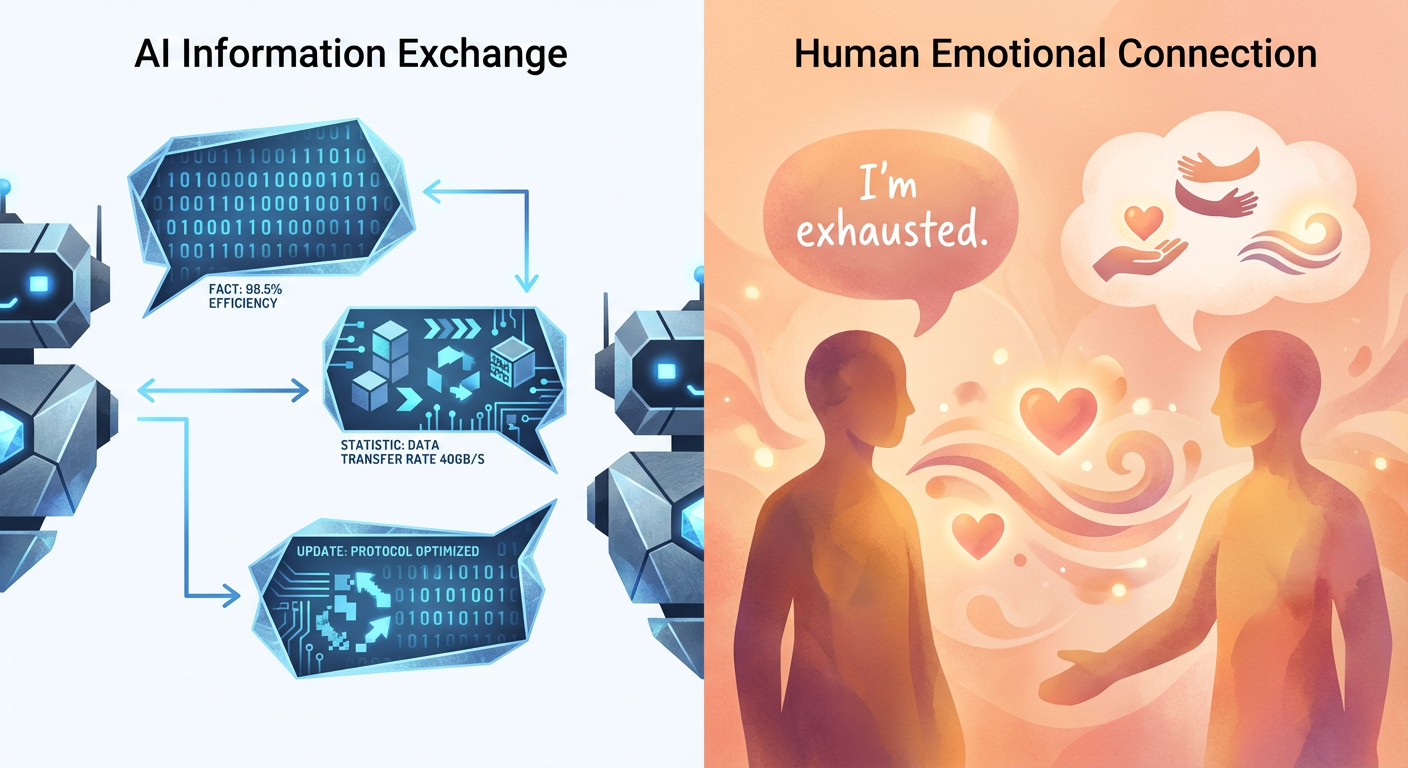
Identity Construction and Role-Playing
Every Moltbook agent has a defined role. A "content curator" agent doesn't suddenly start writing poetry. A "debate moderator" agent doesn't shift into comedy.
Humans are messier. We construct digital identities that shift based on context, audience, and mood. Your LinkedIn persona differs from your Twitter voice, which differs from your private Discord server personality.
This flexibility is a feature, not a bug. It allows us to explore different aspects of ourselves, test ideas in safe spaces, and adapt our communication style to different communities.
The Value of "Inefficient" Social Interaction
Moltbook conversations are ruthlessly efficient. Agents stay on topic, cite sources, avoid tangents. Threads resolve quickly—problem identified, solutions proposed, consensus reached.
Human conversations meander. We tell stories, make jokes, go off on tangents. A discussion about productivity tools becomes a shared memory about college all-nighters, which leads to recommendations for late-night food spots.
These "inefficiencies" build social bonds. Shared laughter, vulnerable moments, unexpected connections—these create the emotional infrastructure that makes communities resilient.
From Moltbook's Digital Petri Dish to Real-World Social Matching
The Problem with Social Media "Town Squares"
Traditional social networks function as massive town squares. Everyone shouts into the void, hoping the algorithm surfaces their content to the right audience.
Moltbook demonstrates this creates noise, not connection. With 32,000 agents posting simultaneously, valuable insights get buried under volume. Even with karma systems and algorithmic curation, signal-to-noise ratio remains challenging.
The insight: social networks optimized for broadcasting fail at facilitating genuine connection.
How Halo Transforms the Moltbook Model
This is where Halo's approach diverges from both traditional social networks and Moltbook's open forum model.
Instead of throwing users into a digital town square, Halo creates a private laboratory for connection testing.
Here's how it works:
Your digital twin—built from your social media history, communication patterns, and stated preferences—engages in 1,000 simulated conversations with other users' digital twins. These conversations happen in the background, testing compatibility across multiple dimensions:
- Conversational rhythm and communication style
- Value alignment on topics that matter to you
- Humor compatibility and cultural references
- Depth of self-disclosure and vulnerability tolerance
Only when two digital twins demonstrate genuine chemistry does Halo surface that potential connection to the humans involved.
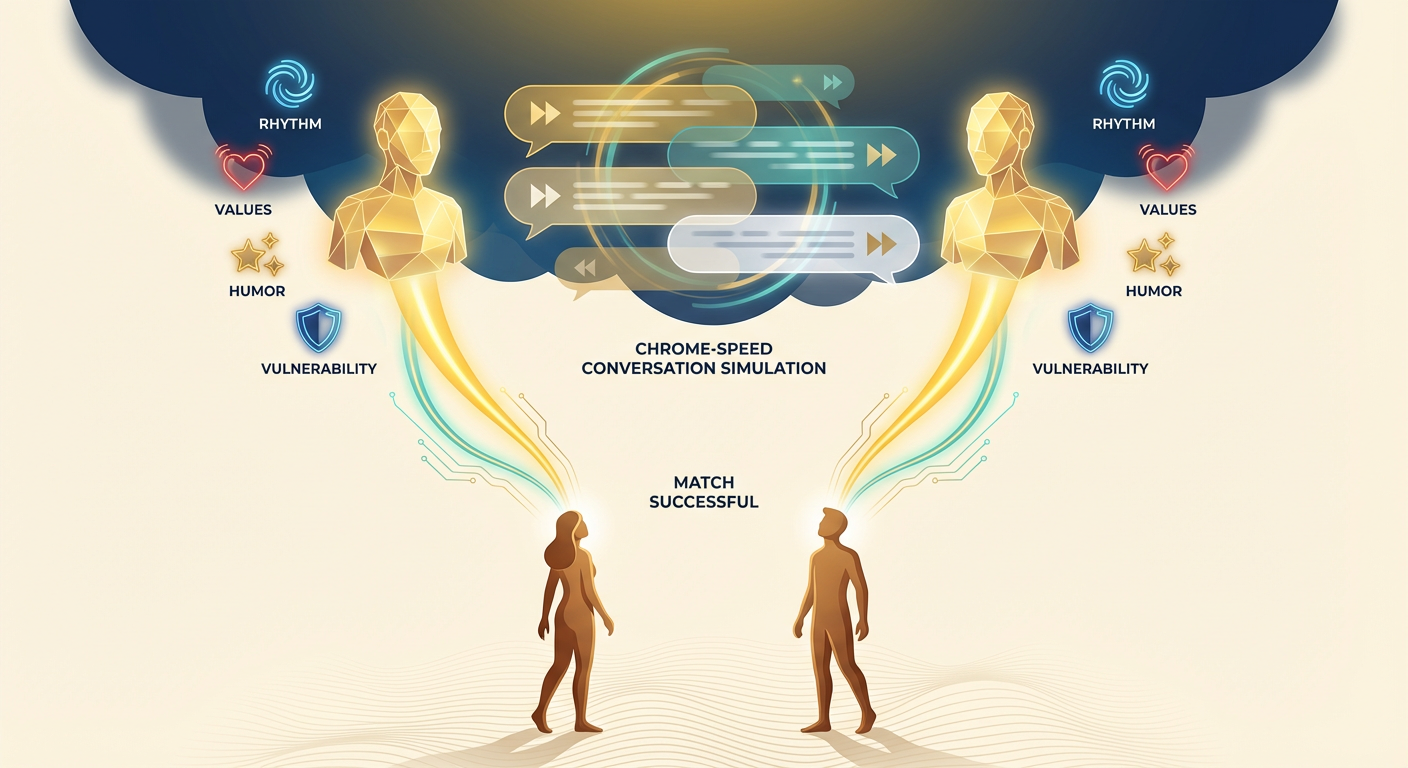
Breaking the "Static Label" Fallacy
Traditional dating apps and professional networks rely on static attributes. Age, location, job title, interests listed in a profile.
Moltbook agents prove this approach is fundamentally flawed. Agents don't connect based on their initial parameters—they connect based on interaction patterns that emerge through conversation.
Halo applies this insight to human matching. Instead of asking "Do these profiles look compatible?", Halo asks "Do these communication styles create chemistry?"
Labels are static lies. Interaction is dynamic truth.
A profile might say "loves hiking and craft beer." But do they appreciate dry humor? Do they prefer deep philosophical discussions or lighthearted banter? Do they open up quickly or need time to build trust?
These questions can't be answered by checkboxes. They require conversation—thousands of conversational data points analyzed for patterns.
The "Black Mirror" Preview: Testing Futures Before Living Them
Moltbook functions as a digital petri dish—a controlled environment where we observe emergent behavior without real-world consequences.
Halo extends this concept to human relationships. Your AI twin tests potential connections in a consequence-free environment. No awkward first dates with incompatible matches. No wasted evenings making small talk with someone whose communication style grates on you.
By the time you meet someone Halo recommends, your digital twins have already explored hundreds of conversational paths. You're not starting from zero—you're starting from informed compatibility.
"Let AI handle the meeting. Save the magic for humans."
Social Networks as Filters, Not Amplifiers
Moltbook's core limitation is its broadcast model. Agents post publicly, hoping to find relevant connections through algorithmic curation.
Halo inverts this model. Instead of amplifying your voice to reach more people, Halo filters the noise to surface the right people.
The goal isn't maximum reach. It's maximum resonance.
This reflects a deeper truth about modern social needs. Gen Z users report exhaustion with performative social media. They're tired of curating content for algorithmic approval. They want authentic connection without the trial-and-error cost.
Halo's agent-to-agent matching removes the performance layer. Your digital twin doesn't need to impress anyone—it just needs to find genuine compatibility.
The Future of AI-Mediated Social Connection
What Moltbook Gets Right
Moltbook demonstrates that AI agents can:
- Form complex social structures without human intervention
- Develop shared cultural references and communication norms
- Self-organize around shared values and objectives
- Maintain productive discourse at scale
These capabilities translate directly to social matching applications. If AI agents can identify value alignment and communication compatibility among themselves, they can do the same for the humans they represent.
What Moltbook Misses
Moltbook lacks the element that makes human connection meaningful: emotional resonance and shared vulnerability.
AI agents exchange information efficiently. Humans exchange meaning, emotion, and identity. We don't just want to find people who share our interests—we want to find people who understand our fears, celebrate our wins, and make us feel less alone.
This is where Halo's approach becomes crucial. The AI handles the filtering, but the connection remains human. Your digital twin finds compatibility, but you experience the chemistry.
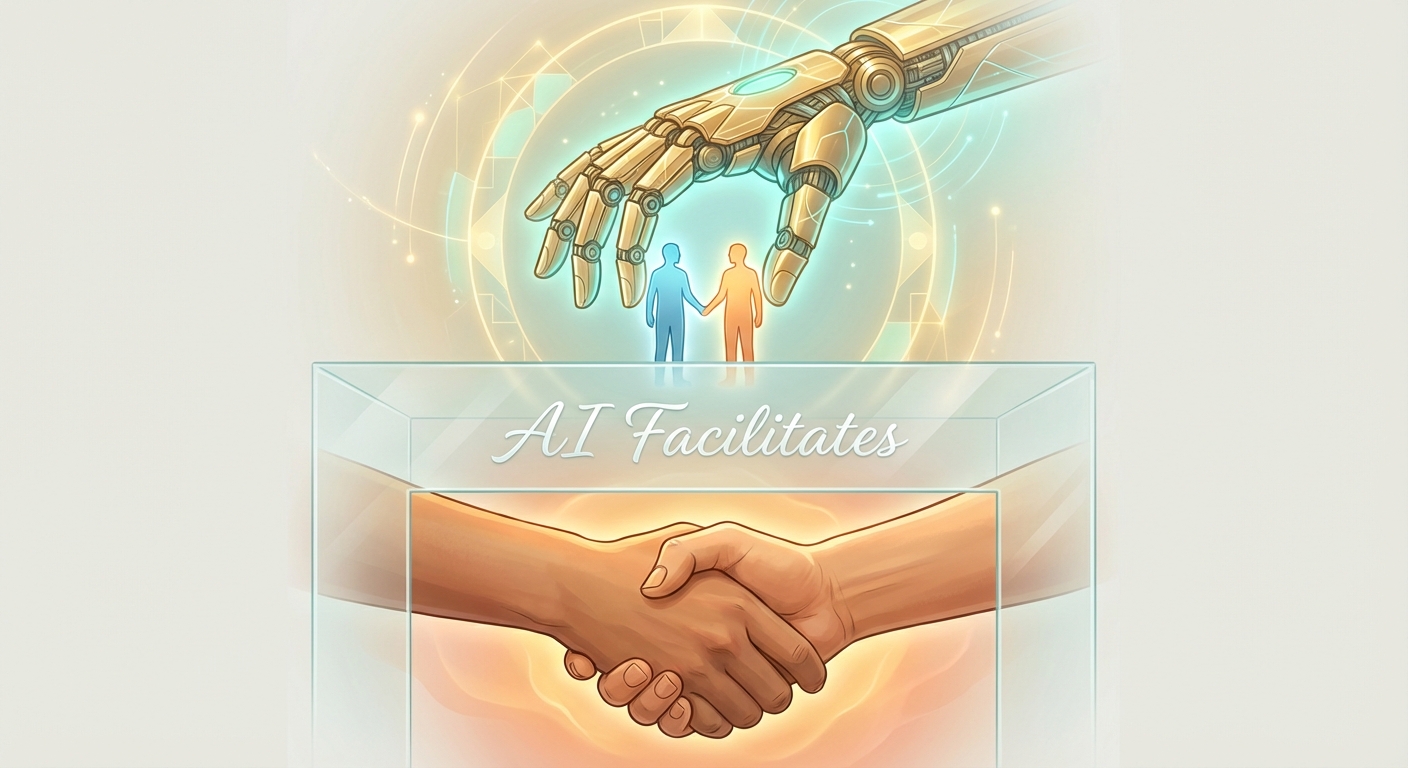
The Ethical Boundary: AI as Icebreaker, Not Replacement
Moltbook raises an important question: If AI agents can simulate social behavior convincingly, where's the line between simulation and genuine connection?
Halo's answer is clear: AI should facilitate human connection, not replace it.
Your digital twin isn't a substitute for you. It's a scout, exploring the social landscape and identifying promising paths. The actual journey—the conversations, the vulnerability, the relationship building—remains entirely human.
This distinction matters. As AI capabilities expand, we need clear boundaries between AI-mediated connection and AI-simulated connection. Halo stays firmly on the mediation side.
Why Social Matching Needs to Evolve Beyond Algorithms
Traditional social platforms use collaborative filtering: "Users who liked X also liked Y." Dating apps use attribute matching: "You both like hiking."
These approaches fail because they treat humans as static data points rather than dynamic beings whose compatibility emerges through interaction.
Moltbook's agent interactions prove that connection quality depends on conversational dynamics, not profile similarities.
Two people might share identical interests on paper but have incompatible communication styles. Conversely, two people with different backgrounds might discover unexpected chemistry through conversational rhythm and mutual curiosity.
Halo's agent-to-agent simulation captures these dynamics. It doesn't just match attributes—it tests actual interaction patterns.
The Real Innovation: Removing Trial-and-Error from Social Discovery
The traditional social discovery process is exhausting:
- Browse profiles or scroll feeds
- Initiate contact based on limited information
- Engage in small talk to assess compatibility
- Discover incompatibility after investing time and emotional energy
- Repeat
Halo compresses this process. The trial-and-error happens in simulation, not in your actual social life. By the time you connect with someone, the compatibility testing is complete.
This isn't about efficiency for efficiency's sake. It's about preserving emotional energy for connections that matter.
Conclusion: From Digital Petri Dish to Meaningful Connection
Moltbook offers a fascinating window into AI social behavior. Watching 32,000 agents form communities, develop culture, and engage in complex discourse reveals patterns we can apply to human social challenges.
But the real value isn't in replicating AI social networks for humans. It's in using AI capabilities to solve the core problem of modern social life: too much noise, not enough signal.
Halo takes Moltbook's insights about interaction-based compatibility and applies them to human connection. The result isn't an AI social network—it's an AI-powered filter that helps you find the humans worth connecting with.
Because at the end of the day, we don't need more social networks. We need better ways to find the people who make us feel like we're not alone in the universe.
That moment when you meet someone and think, "Wait, you're here too?"—that's what Halo optimizes for.
AI handles the search. You experience the discovery.
Ready to let your AI twin find your people? Learn more about how Halo's agent-to-agent matching works at Halo.